BooksCloud
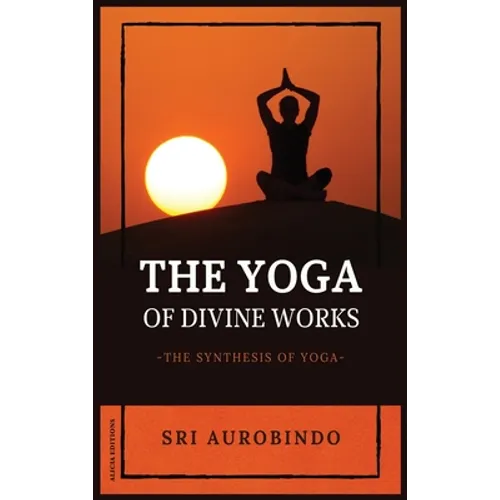
The Yoga of Divine Works: The Synthesis of Yoga - Hardcover
The Yoga of Divine Works: The Synthesis of Yoga - Hardcover
Couldn't load pickup availability
by Sri Aurobindo (Author)
"ALL LIFE IS YOGA."
In The Yoga of Divine Works, drawn from The Synthesis of Yoga, Sri Aurobindo presents action not as an obstacle to spiritual life but as its starting point. Yoga, in this vision, is not withdrawal from the world but a conscious transformation of life itself.
Every action, when aligned with the Divine Will, becomes a means of inner growth. Works are purified of ego, redirected toward the Eternal, and ultimately transfigured into instruments of a higher consciousness. Knowledge illumines action; love crowns it. Through this integral process, human life is progressively divinized.
Sri Aurobindo's teaching goes beyond traditional Karma Yoga. It articulates a comprehensive spiritual discipline in which will, knowledge, and devotion unite. The goal is not individual escape but the manifestation of a greater consciousness within earthly existence - a divine life in the world.
Philosophically rigorous yet spiritually luminous, this volume remains one of the most demanding and transformative expositions of Yoga in modern spiritual literature.
The Integral Yoga Series presents selected writings from The Synthesis of Yoga, offering a progressive exploration of action, devotion, and knowledge as three complementary paths to spiritual transformation and divine realization.
Sri Aurobindo (1872-1950) was an Indian philosopher, yogi, poet, and founder of Integral Yoga. His interpretation of the Gita has become one of the most influential modern readings within Hindu philosophical and spiritual discourse.
EXCERPT: ALL YOGA is in its nature a new birth; it is a birth out of the ordinary, the mentalised material life of man into a higher spiritual consciousness and a greater and diviner being. No Yoga can be successfully undertaken and followed unless there is a strong awakening to the necessity of that larger spiritual existence. The soul that is called to this deep and vast inward change, may arrive in different ways to the initial departure. It may come to it by its own natural development which has been leading it unconsciously towards the awakening; it may reach it through the influence of a religion or the attraction of a philosophy; it may approach it by a slow illumination or leap to it by a sudden touch or shock; it may be pushed or led to it by the pressure of outward circumstances or by an inward necessity, by a single word that breaks the seals of the mind or by long reflection, by the distant example of one who has trod the path or by contact and daily influence. According to the nature and the circumstances the call will come.
Share